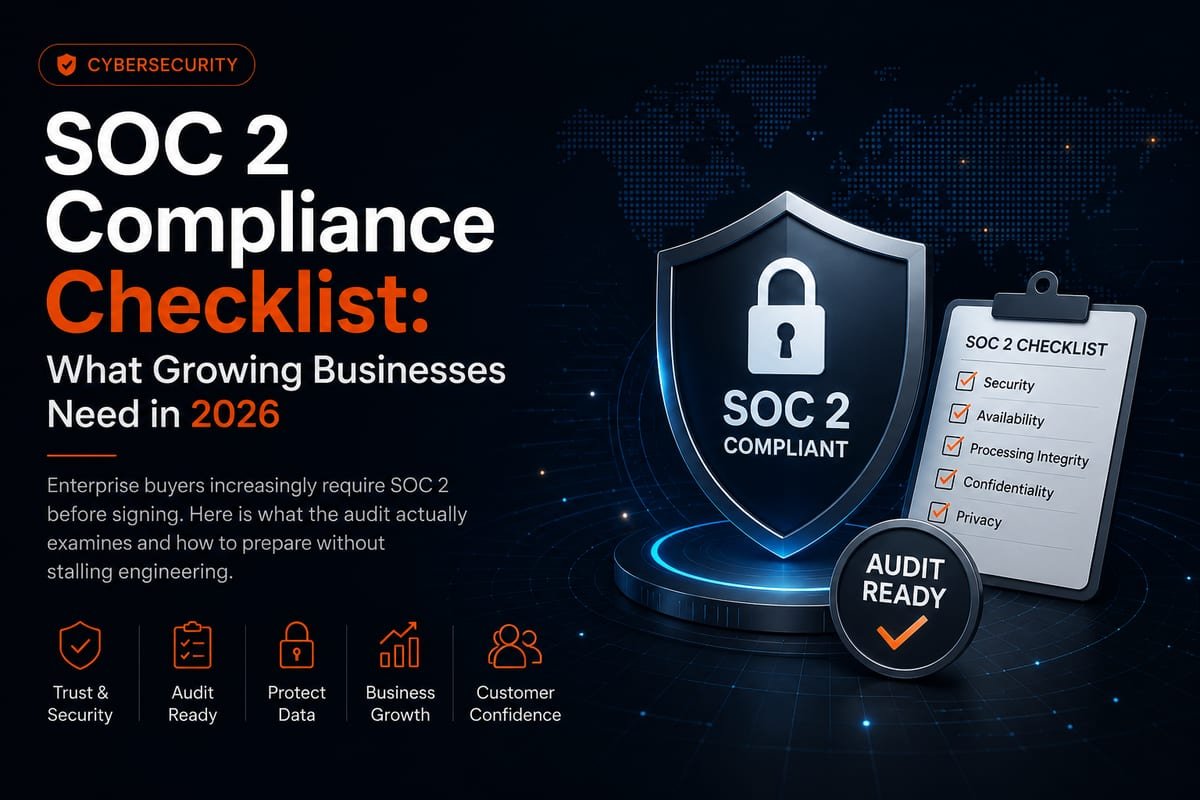
Enterprise buyers increasingly require SOC 2 before signing. Here is what the audit actually examines and how to prepare without stalling engineering.
For a growing software or services business, SOC 2 has shifted from a differentiator to a gate. Enterprise procurement teams routinely ask for a report before contracts progress, and the absence of one increasingly ends deals before technical evaluation begins. That commercial pressure is why most companies start the process, and why many start it later than they should.
The good news is that SOC 2 is less prescriptive than its reputation suggests. It does not mandate specific tools or a particular architecture. It asks you to define controls appropriate to your business and then demonstrate that you actually follow them. The difficulty is rarely the controls themselves — it is producing evidence that they operated consistently over time.
Type I versus Type II, and which you need
A Type I report assesses whether your controls are suitably designed at a single point in time. A Type II report assesses whether they operated effectively across a period, typically three to twelve months. Type I is faster to obtain and useful for unblocking an immediate deal, but most enterprise buyers ultimately want Type II.
The pragmatic path for most companies is to pursue Type I first, then run a Type II observation window immediately afterwards. This gets a report in hand quickly while the longer evidence period accumulates, rather than waiting the better part of a year with nothing to show a prospect.
The controls auditors consistently examine
Across engagements, the same areas generate the most findings. Working through these before an auditor arrives removes most of the pain from the process.
- Access control — single sign-on, enforced multi-factor authentication, role-based permissions, and documented joiner-mover-leaver processes with evidence that access was actually revoked
- Change management — every production change traceable to a reviewed pull request, with approvals recorded and no direct pushes to main
- Encryption — data encrypted in transit and at rest, with documented key management
- Logging and monitoring — centralised logs, alerting on security-relevant events, and retention that meets your stated policy
- Vendor management — an inventory of third parties handling your data, with their security posture reviewed and recorded
- Incident response — a written plan, defined severities and owners, and evidence that it has been tested rather than merely written
- Business continuity — tested backups and a documented recovery objective, with proof that a restore has actually been performed
Evidence is the real work
Teams routinely underestimate this. Having multi-factor authentication enabled is not the control being tested — demonstrating that it was enforced for every user throughout the observation window is. If your evidence collection relies on someone taking screenshots each quarter, it will consume weeks of engineering time and it will have gaps.
This is why compliance automation platforms have become standard. They connect to your cloud provider, identity provider and code repository, and continuously collect the evidence auditors ask for. The tooling is not free, but it costs materially less than the engineering hours it replaces, and it catches drift as it happens instead of at audit time.
A realistic timeline
For a company starting from a reasonable baseline — cloud infrastructure, SSO already in place, code review already practised — expect roughly two to three months of readiness work before a Type I audit, then a three month minimum observation window for Type II. Companies starting without those foundations should plan for longer, because the gap analysis usually surfaces work that touches production systems.
The most common cause of overrun is treating compliance as a project that runs alongside normal delivery without any allocated capacity. Controls that require engineering changes — centralised logging, access reviews, backup testing — need to be scheduled like any other work, or they slip until the audit forces them.
Compliance as a security outcome
It is worth saying plainly that SOC 2 is not the same as being secure. It is possible to pass an audit while carrying real risk, and it is possible to be well defended without a report. Treating the framework as a floor rather than a finish line is what turns the exercise into genuine risk reduction rather than paperwork.
Smikap's Cybersecurity practice prepares businesses for SOC 2 and ISO 27001 by closing control gaps first and then structuring evidence collection so audits stay routine rather than disruptive. If a customer has recently asked you for a report, the earlier the gap analysis happens, the less it interferes with your roadmap.