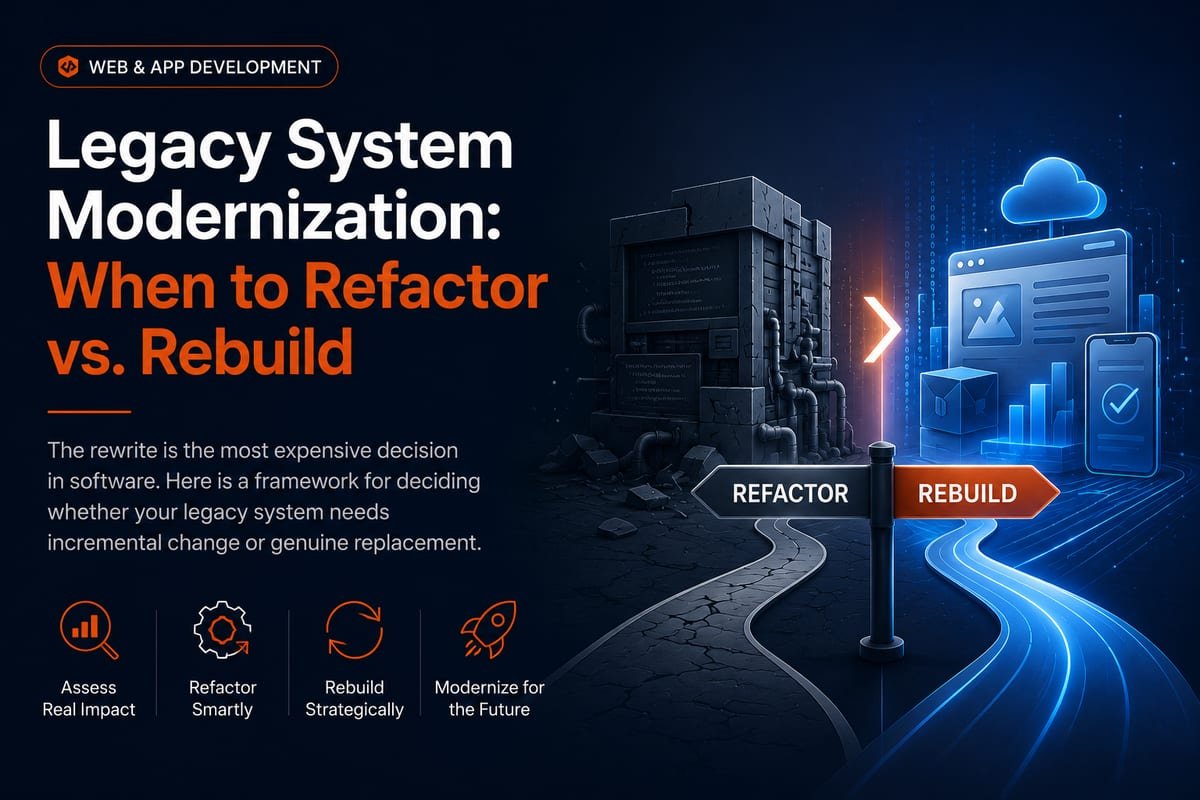
The rewrite is the most expensive decision in software. Here is a framework for deciding whether your legacy system needs incremental change or genuine replacement.
Every legacy system reaches a point where the team stops proposing improvements and starts proposing replacement. Deploys have become frightening, onboarding takes months, and features that should take days take quarters. At that moment the instinct is almost always to rebuild from scratch, and that instinct is right considerably less often than engineers believe.
Full rewrites fail at a notoriously high rate, and the reasons are consistent. The existing system contains years of undocumented business logic accumulated from real edge cases. The rewrite has to reach feature parity before it delivers any value, which means a long period of paying for two systems while shipping nothing new. Meanwhile the old system keeps changing, and the target moves.
Diagnose the actual problem first
Before choosing an approach, be precise about what is wrong. Teams often describe a system as legacy when the real constraint is narrower and much cheaper to fix. A system that is slow because of missing database indexes does not need replacing. A system that is frightening to deploy because there are no tests needs tests, not a new language.
- Is the pain in one module or spread across the codebase?
- Is the runtime or framework still supported and receiving security patches?
- Can you hire people who know this stack, at a reasonable cost?
- Is the business logic documented anywhere other than in the code itself?
- Does the architecture prevent something the business now needs, or is it merely unfashionable?
If the pain concentrates in a handful of modules and the platform is still supported, incremental refactoring will almost always deliver value sooner and at lower risk. If the runtime is end-of-life, the talent pool has evaporated, or the architecture structurally blocks a strategic requirement, replacement becomes the honest answer.
The case for incremental modernization
Incremental modernization keeps the system running and delivering while it improves. The usual sequence is to establish a safety net of tests around current behaviour, upgrade dependencies and runtime versions, extract the worst-coupled modules behind clear interfaces, and improve the deployment pipeline so changes become routine rather than risky.
It is slower in the sense that it never produces a dramatic before-and-after moment. It is faster in the sense that value arrives continuously and the business is never asked to wait eighteen months for parity with what it already has.
When replacement is genuinely warranted
When replacement is the right call, the way to do it is to avoid a big-bang cutover. The strangler pattern — routing traffic through a facade and moving functionality across one capability at a time — lets the old and new systems coexist while risk is retired gradually. Each migrated slice delivers value on its own, and each one can be rolled back independently if it misbehaves.
- Put a routing layer in front of the existing system so traffic can be redirected per capability
- Choose a first slice that is valuable but low-risk, and migrate it end to end including data
- Run both paths in parallel and compare outputs before switching traffic over
- Decommission the replaced code path deliberately, rather than leaving it in place indefinitely
- Repeat, keeping the old system fully operational until the last capability has moved
Budget for the parts that are always underestimated
Two costs consistently blow modernization budgets. The first is data migration, which invariably surfaces years of inconsistent records that the old system tolerated and the new one will not. The second is undocumented behaviour — the conditional added five years ago for one important customer that nobody remembers but which will generate a support escalation the day it disappears.
Both are manageable if planned for. Both derail projects when the plan assumes the existing system does what the documentation says it does.
Making the decision
The question worth asking is not whether the current system is good. It is whether the cost of continuing to work within it exceeds the cost and risk of changing it, over a horizon the business actually cares about. That calculation frequently favours disciplined incremental work, even when the codebase is genuinely unpleasant.
Smikap's Web and App Development practice starts modernization engagements with a codebase and architecture audit precisely so this decision is made on evidence rather than frustration. If your team is currently arguing about whether to rewrite, an outside assessment is usually the cheapest way to settle it.