
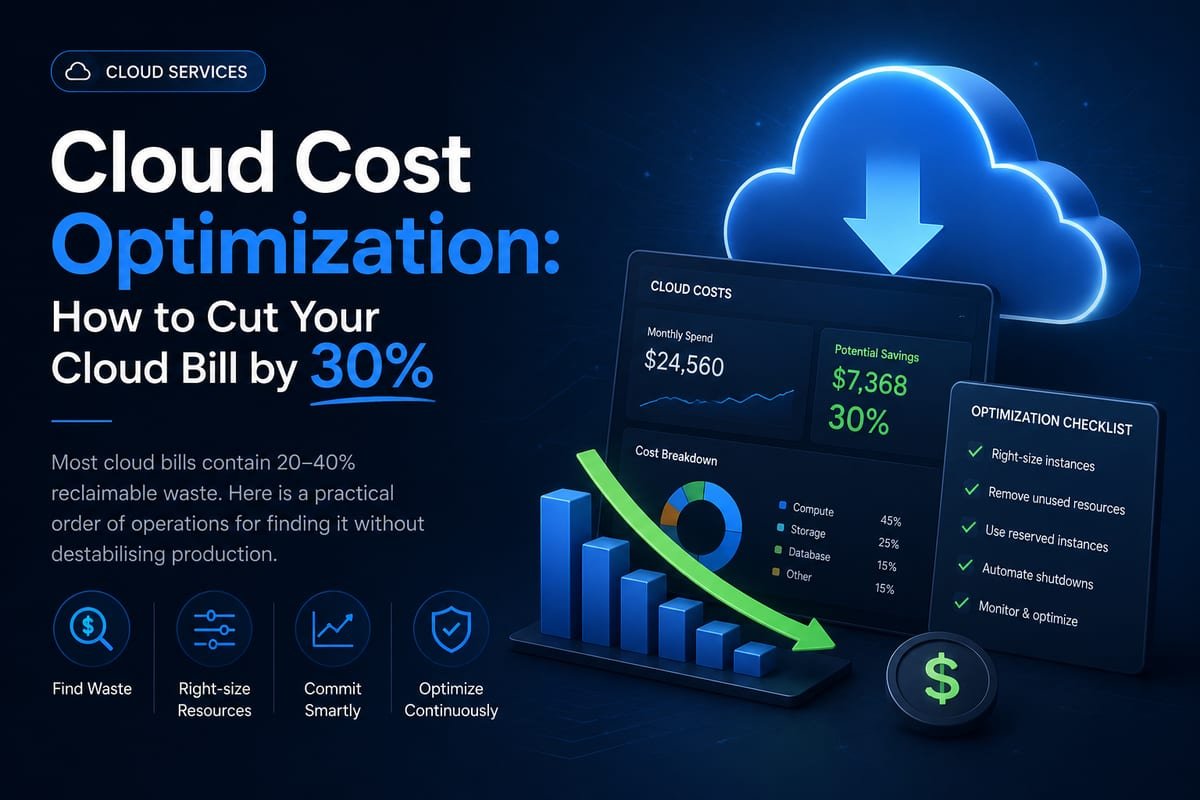
Most cloud bills contain 20-40% reclaimable waste. Here is a practical order of operations for finding it without destabilising production.
Cloud spend has a way of growing quietly. A workload gets provisioned generously to avoid a launch-day incident, an environment gets spun up for a test and never torn down, and a year later nobody remembers why half the line items exist. In nearly every cost review we run, somewhere between a fifth and two fifths of the bill turns out to be reclaimable without touching performance.
The reason it persists is organisational rather than technical. Engineers are measured on reliability, not efficiency, so the safe choice is always to over-provision. Finance sees a single large invoice with no attribution back to teams or products. Nobody owns the number, so nobody reduces it.
Start with visibility, not cuts
Before changing anything, you need to know what you are spending money on and who is responsible for it. That means a consistent tagging strategy applied across every resource — environment, team, product, cost centre. Untagged resources are where waste hides, and in most estates they represent a substantial share of spend.
Once tagging is in place, allocate costs back to the teams generating them and make that visible. Simply showing engineering leads what their services cost per month changes behaviour more reliably than any top-down mandate, because it turns an abstract corporate number into something a team can act on.
The reductions that carry no risk
Some savings require no architectural change and no meaningful risk. These should be exhausted first, because they buy credibility for the harder work that follows.
- Delete orphaned resources — unattached storage volumes, idle load balancers, old snapshots and unused static IPs accumulate silently
- Schedule non-production environments — development and staging rarely need to run outside working hours, which alone removes roughly two thirds of their cost
- Apply storage lifecycle rules — move infrequently accessed data to cheaper tiers automatically instead of keeping everything on hot storage
- Clean up old snapshots and container images, which are cheap individually and expensive in aggregate
- Review data transfer paths, since cross-region and egress charges are frequently the largest surprise on a bill
Rightsizing without destabilising production
Rightsizing is where the largest savings usually sit, and also where teams are most nervous. The key is to base decisions on observed utilisation over a meaningful window — at least two weeks, ideally covering a month-end or whatever your peak cycle is — rather than on instinct.
Look for instances running consistently below twenty percent CPU with headroom on memory. Reduce one size at a time, verify against your performance baselines, and keep the change reversible. Where workloads are genuinely variable, autoscaling is a better answer than a permanently larger instance, though it requires that the application handles instances appearing and disappearing gracefully.
Commit only to what you are certain about
Reserved instances and savings plans offer substantial discounts in exchange for a one or three year commitment. They are genuinely valuable, but only once you have finished rightsizing. Committing to a baseline you have not yet optimised locks in your current inefficiency for the length of the term.
The sensible sequence is to clean up waste, rightsize, observe the resulting steady-state baseline for a month or two, then commit to the portion of that baseline you are confident will persist. Cover your stable floor with commitments and let genuinely variable capacity run on demand.
Make it continuous, not annual
A one-off optimisation project produces a sharp drop followed by a steady climb back. Costs regrow because the conditions that created them have not changed. What prevents this is a lightweight recurring process: a monthly review of the largest cost movers, budget alerts that fire before month end rather than after, and cost visibility built into the same dashboards engineers already look at.
Smikap's Cloud Services practice runs cost optimisation reviews that typically surface twenty to forty percent in reclaimable spend, then puts the tagging, alerting and autoscaling in place so the savings hold. If your bill has been climbing faster than your usage, that gap is usually recoverable.